 walwet

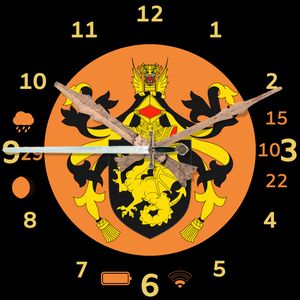
WATCH FACE FOR WEAR OS (WFF), WEAR OS (LEGACY) & Tizen
Freistaat Bayern
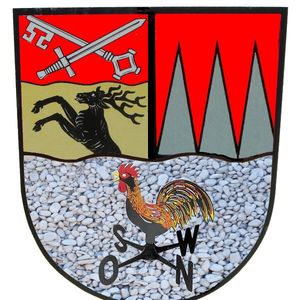
The "Franconian rake"
The second field is divided by red and white (silver) with three peaks rising from white. This "rake" appeared around 1350 as the coat of arms of some places of the Bishopric of Würzburg and since 1410 also in the seals of the prince bishops. Today the Franconian rake stands for the administrative districts of Upper Franconia, Middle Franconia and Lower Franconia.
The Blue Panther
At the bottom left in the third field is an erect, blue, gold-armored panther (Pantier) on a white (silver) background. It was originally included in the coat of arms of the Counts Palatine of Ortenburg in Lower Bavaria. The Wittelsbach family later took it over. Today the blue panther represents the old Bavarian administrative districts of Lower Bavaria and Upper Bavaria.
The three black lions
In the fourth field, three black, red-armored lions arranged one on top of the other are depicted on gold. They are taken from the old coat of arms of the Hohenstaufen family, the former Dukes of Swabia. In the national coat of arms, these three lions represent the administrative district of Swabia.
The white and blue heart shield
is diagonally diamond-shaped in white (silver) and blue. Formerly the coat of arms of the Counts of Bogen, it was adopted in 1242 by the Wittelsbach family as their main coat of arms. Today, the white and blue rhombuses are considered a Bavarian symbol and are also officially used as the "Small State Coat of Arms".
The shield-holding lions
The two shield-holding lions continue a 14th-century tradition.
Published on Feb 26, 2022